

Love may not have a price tag, but many Americans still find themselves opening their wallets to show they care. From everyday gestures to lavish gifts, “spoiling” a partner means something different to everyone.
To find out how far people really go, we surveyed thousands of Americans in relationships about how often they surprise their partner, how much they spend, and how important being spoiled is in feeling loved. We also created a ‘Spoil Score’ to uncover which states go above and beyond — not just through gifts, but through the small, thoughtful actions that keep relationships strong.
Key Findings
- Most Americans keep it simple. Two-thirds (66%) spend less than $500 a year spoiling their partner outside of birthdays or holidays, while 1 in 6 (16%) spend more than $1,000.
- Love sometimes costs extra. Nearly 1 in 4 (24%) have gone into debt just to spoil their partner.
- Big gestures still happen. About 1 in 3 (31%) say the most expensive gift they’ve ever given a partner cost $1,000 or more — including 7% who’ve spent over $5,000.
- Not every gift hits the mark. More than half (53%) have pretended to like a present from their partner.
- Spoiling isn’t everything. While 66% say being spoiled is not necessary to feel loved, 1 in 3 still believe thoughtful indulgence plays an important role in a relationship.
How America Spoils its Partners
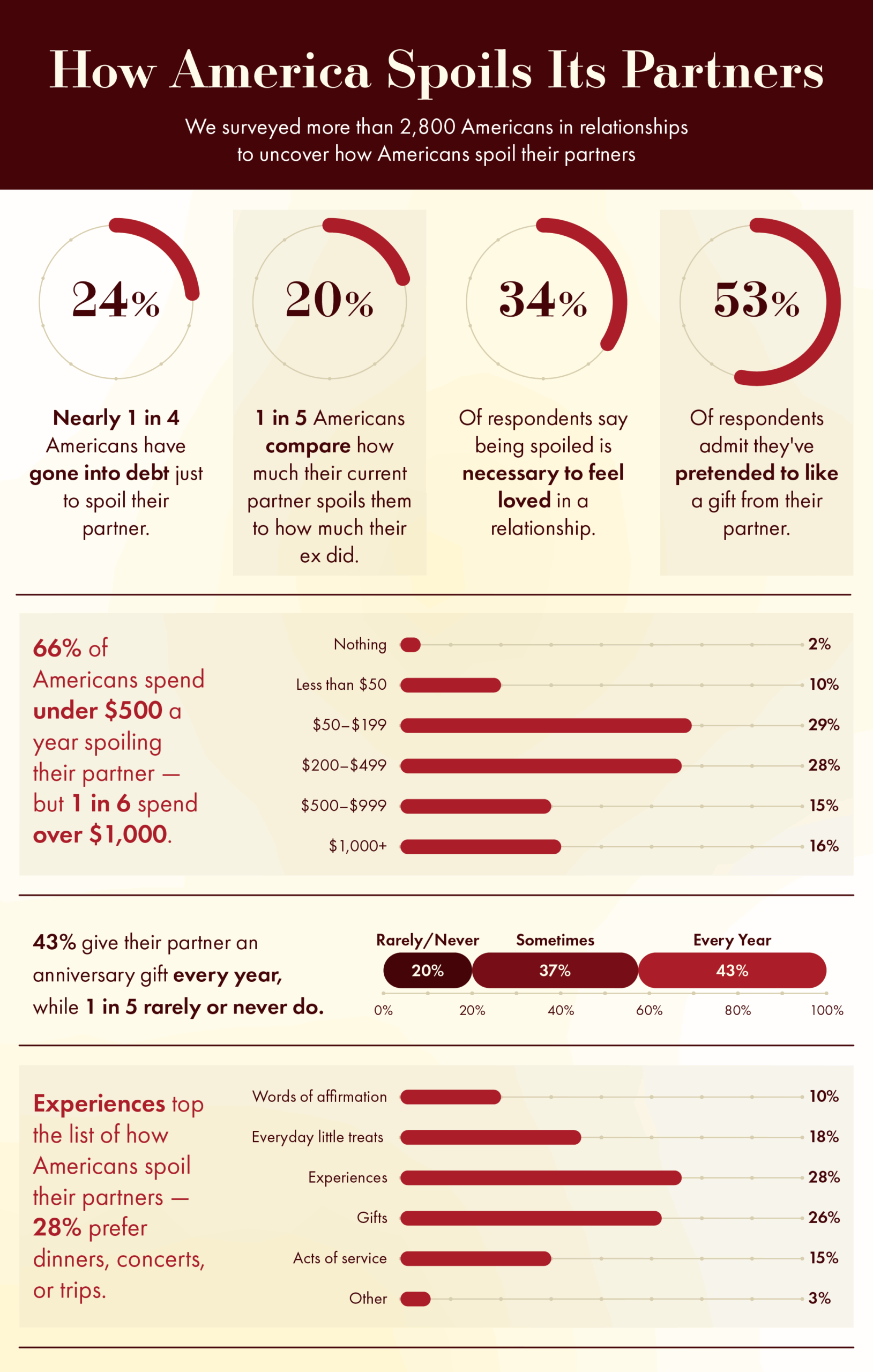
When it comes to spoiling a partner, most people don’t rely on luxury. They lean into consistency, intention, and emotional payoff. As a result, spending styles vary widely.
Two-thirds (66%) spend less than $500 a year on non-holiday gifts and treats, while about one in six (16%) invest more than $1,000 annually. Still, generosity can come at a cost: nearly one in four people (24%) admit they have at some point gone into debt to spoil their partner.
Big gestures aren’t uncommon. Nearly one in three (31%) say the most expensive gift they’ve ever given cost at least $1,000, and 7% say they’ve crossed the $5,000 mark. However, 19% say their most extravagant gift was under $200, suggesting that meaning matters more than price for many couples.
Holiday and birthday gifting follow similar trends:
- 48% spend between $50–$199 on a birthday gift
- 43% give an anniversary gift every year, while 20% rarely or never do
- On holidays, 48% buy three or more gifts, and 18% spend over $500
- Valentine’s Day stands out as a smaller celebration, with 38% spending under $50 and 21% skipping gifts altogether.
But spoiling isn’t always financial. More than one in four people (28%) say their favorite way to spoil a partner is by planning experiences — dinners, concerts, or trips that create memories. Over half (52%) believe their efforts are always noticed, although 1 in 10 feel their gestures often go unseen. And despite best intentions, 53% admit they’ve pretended to like a gift they received.
There’s also an unspoken comparison game at play: 20% of Americans say they compare how much their current partner spoils them to how an ex did. Even so, two-thirds (66%) say they don’t need to be spoiled to feel loved, while 34% say it plays an important role in feeling valued in a relationship.
Ranking the States that Spoil Their Partners Most
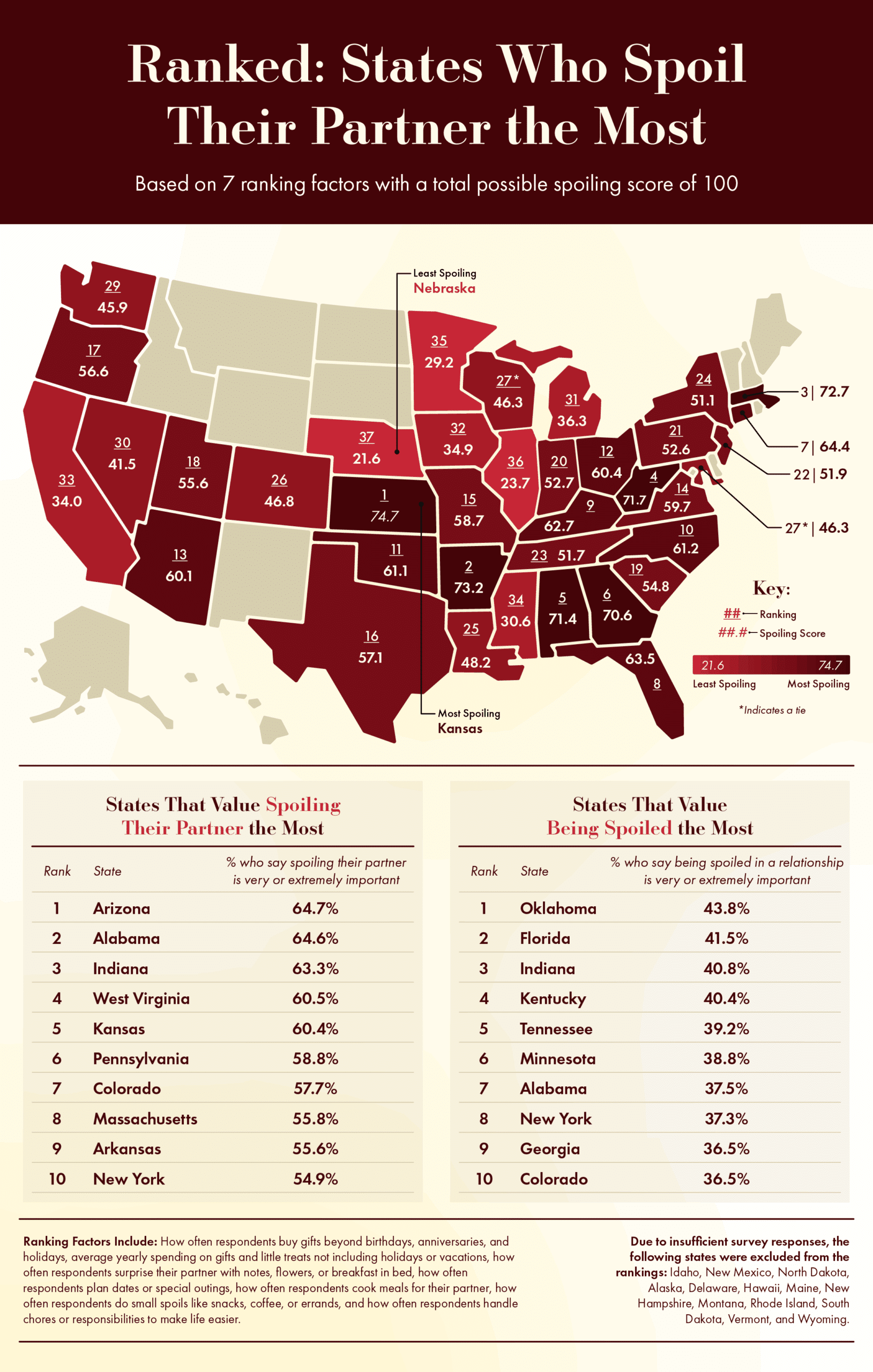
Love may be universal, but the way people express it varies by geography. To see where romantic generosity thrives, we created a Spoil Score based on seven behaviors — from buying surprise gifts to running errands and planning dates. Scores reflect how often respondents in each state reported engaging in these spoiling behaviors. Each state received a score out of 100 to show how often residents go out of their way to make their partner feel appreciated.
Here’s where spoiling is part of everyday life and where it’s more of a special-occasion thing.
Top Five States That Spoil the Most
- Kansas — 74.7 / 100
- 88% regularly buy gifts outside of holidays
- 60% say spoiling their partner is very or extremely important
- 77% say “I love you” multiple times a day
- Arkansas — 73.2 / 100
- 52% do small spoils (errands, snacks, little surprises) several times a week
- 54% handle daily chores to make life easier for their partner
- 74% cook for their partner at least once a week
- Massachusetts — 72.7 / 100
- 46% surprise their partner at least monthly
- 52% take care of daily responsibilities to support their partner
- 21% spend over $500 annually on small treats outside holidays
- West Virginia — 71.7 / 100
- 77% buy non-holiday gifts multiple times a year
- 44% surprise their partner at least once a month
- 42% perform everyday spoils several times a week
- Alabama — 71.4 / 100
- 65% say spoiling their partner is very or extremely important
- 19% surprise their partner weekly
- 50% handle daily chores or responsibilities to make life easier
Bottom Five States That Spoil the Least
- Nebraska — 21.6 / 100
- 54% spend under $100 a year on non-holiday gifts
- 20% say spoiling their partner is not important
- 20% rarely or never surprise their partner
- Illinois — 23.7 / 100
- 23% rarely or never buy gifts outside major occasions
- 30% rarely or never plan dates
- 36% say spoiling simply isn’t a priority
- Minnesota — 29.2 / 100
- 22% only give gifts on special occasions
- 31% spend under $100 annually on small treats
- 18% only plan dates for big occasions
- Mississippi — 30.6 / 100
- 24% rarely or never do small gestures like picking up coffee or running errands
- 10% rarely or never help with chores
- 39% spend under $100 annually on non-holiday spoiling
- California — 34.0 / 100
- 20% only buy gifts on special occasions
- 59% don’t regularly surprise their partner (39% do so only a few times/year, 20% rarely or never)
- 20% say spoiling their partner isn’t important to them
The States that Value Spoiling and Being Spoiled Most
Not all generosity is about action — sometimes it’s about intention. We asked Americans how important it is to spoil their partner, and separately, how important it is for them to be spoiled in return. The results reveal two different types of romantic priorities: givers and receivers.
States That Value Spoiling Their Partner the Most
(% who say it is very or extremely important to spoil their partner)
- Arizona — 64.7%
- Alabama — 64.6%
- Indiana — 63.3%
- West Virginia — 60.5%
- Kansas — 60.4%
- Pennsylvania — 58.8%
- Colorado — 57.7%
- Massachusetts — 55.8%
- Arkansas — 55.6%
- New York — 54.9%
States That Value Being Spoiled the Most
(% who say being spoiled is very or extremely important to feeling loved)
- Oklahoma — 43.8%
- Florida — 41.5%
- Indiana — 40.8%
- Kentucky — 40.4%
- Tennessee — 39.2%
- Minnesota — 38.8%
- Alabama — 37.5%
- New York — 37.3%
- Georgia — 36.5%
- Colorado — 36.5%
What This Reveals About Relationship Dynamics
Several states — like Indiana, Alabama, and Colorado — appear on both lists, suggesting a reciprocity-based love language: couples in these regions value both giving and receiving thoughtful gestures. In contrast, states such as Arizona and Oklahoma lean more heavily toward one side of the spoiling equation, either as enthusiastic givers or appreciative receivers.
How Each Gender Spoils Their Partners
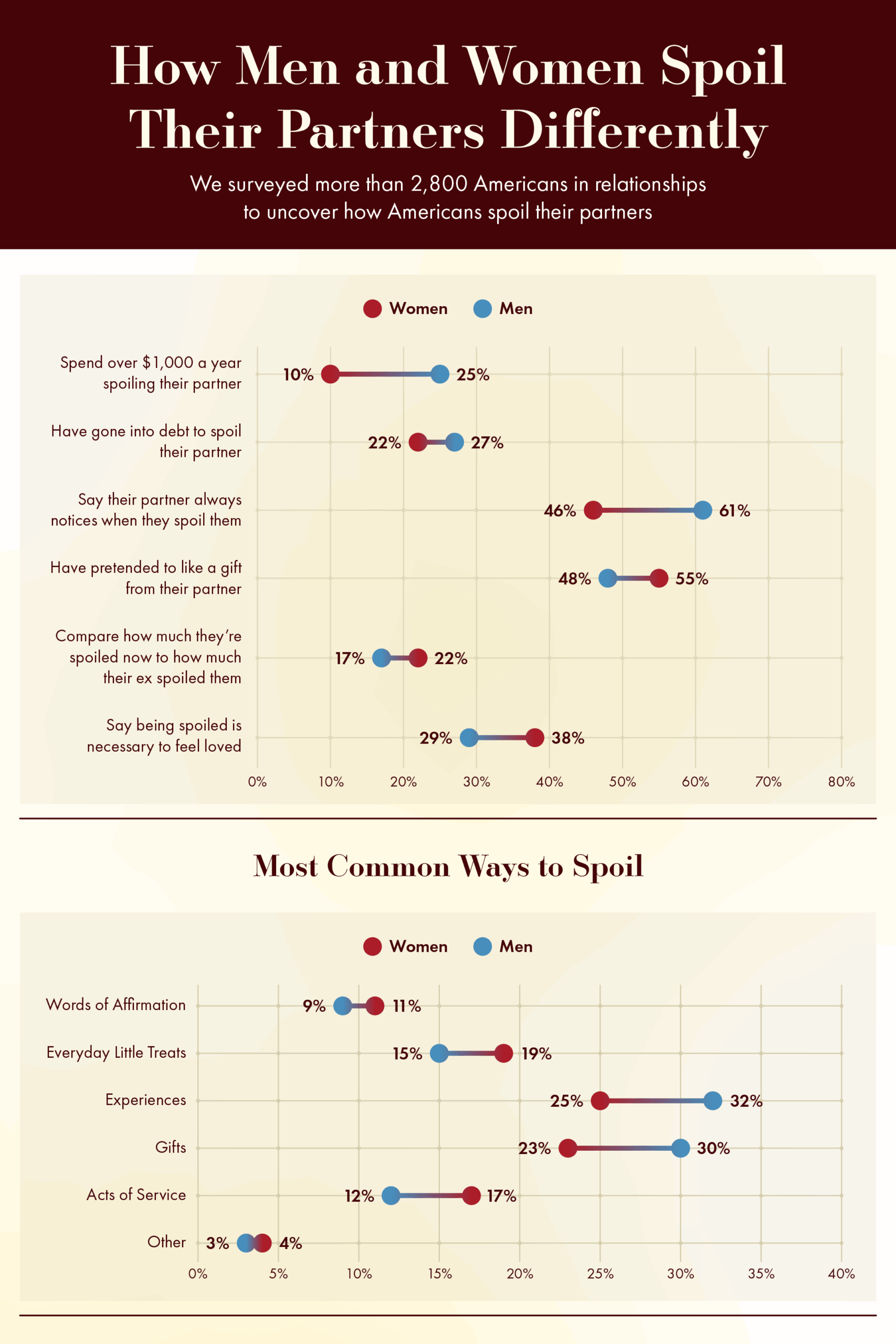
When it comes to spoiling a partner, men and women often show love in different ways — not just in how much they spend, but in the types of gestures they prefer and how they believe those gestures are received.
Spending & Financial Generosity
Men are more likely to go all-in financially when it comes to spoiling:
- 25% of men spend over $1,000 a year on non-holiday spoiling, compared to 10% of women.
- 27% of men have gone into debt to spoil their partner, versus 20% of women.
- Nearly half of men (47%) spend $200 or more on birthday gifts, compared to 29% of women.
This suggests that for many men, financial spending plays a central role in how they show love.
Special Occasions: Anniversaries, Holidays & Valentine’s Day
Men are more consistent with milestone gifting, while women often focus on volume over price:
- 54% of men give an anniversary gift every year, compared to 37% of women.
- Almost 1 in 4 women (23%) say they never give an anniversary gift.
- During the holidays, 50% of women buy three or more gifts, compared to 45% of men, though women are more likely to spend under $50 (17%).
- On Valentine’s Day, 17% of men spend over $200, while 43% of women spend under $50, and 26% don’t give a gift at all.
Preferred Spoiling Styles & Feeling Seen
Love languages also diverge in how spoiling is expressed and perceived:
- 30% of men prefer to spoil through gifts, versus 23% of women.
- 36% of women prefer spoiling through small gestures (notes, errands, surprise treats), compared to 27% of men.
- 61% of men believe their partner “always notices” their efforts, versus 46% of women.
This suggests that men are more confident their spoils are appreciated, while women may feel their care is more subtle and sometimes less acknowledged.
Emotional Reactions: Pretending, Comparing & Needing to Feel Spoiled
Women also report stronger emotional responses tied to being spoiled or not:
- 55% of women have pretended to like a gift from a partner, compared to 48% of men.
- 22% of women compare how they’re spoiled now to previous relationships, versus 17% of men.
- 38% of women say being spoiled is necessary to feel loved, compared to 29% of men.
Overall, women are more likely to associate spoiling with emotional validation, while men are more likely to associate it with tangible action.
What These Differences Reveal
Financial generosity appears to be a dominant spoiling style for many men, while women tend to express care through thoughtful, ongoing gestures. However, women also report being more emotionally sensitive to whether that effort is reciprocated, and also more likely to compare it to what they’ve experienced before.
The States that Say “I Love You” the Most
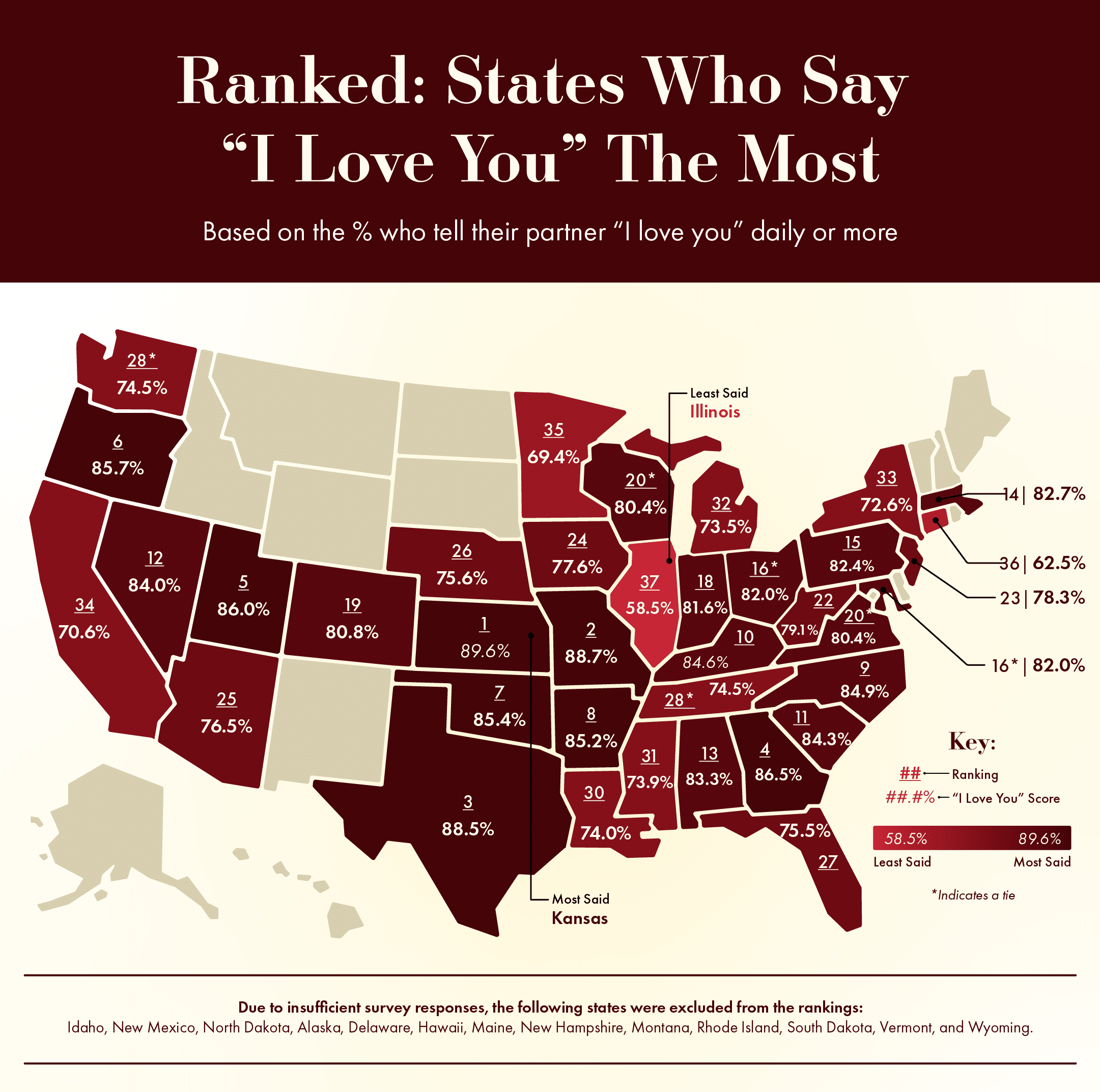
Spoiling a partner doesn’t always involve gifts or grand gestures — sometimes, the most meaningful form of affection is spoken. We asked Americans how often they say “I love you” to their partner, and some states are far more verbally expressive than others.
Here are the top 10 states where residents say “I love you” daily or more:
- Kansas — 89.6%
- Missouri — 88.7%
- Texas — 88.5%
- Georgia — 86.5%
- Utah — 86.0%
- Oregon — 85.7%
- Oklahoma — 85.4%
- Arkansas — 85.2%
- North Carolina — 84.9%
- Kentucky — 84.6%
In Kansas, nearly nine in ten people (89.6%) tell their partner they love them every day — the highest rate in the nation. Several Southern and Midwestern states, such as Georgia, Arkansas, and Oklahoma, also rank high in daily verbal affirmation, suggesting that frequent expressions of love may be closely tied to cultural values around family closeness and emotional openness.
While physical gifts and planned surprises are meaningful, verbal affirmation remains one of the simplest — and most consistent — ways couples express care. For many, saying “I love you” isn’t reserved for special moments; it’s woven into daily connection.
Closing Thoughts
From daily “I love yous” to surprise gestures and even high-end gifts, Americans show love in a wide range of ways. For some, generosity is financial — expressed through dinners, trips, and expensive presents. For others, it’s found in quiet acts of care like running errands, cooking a favorite meal, or remembering the little details that matter most.
While not every partner needs to be spoiled to feel loved, many do value the feeling of being seen, prioritized, and appreciated — whether through money spent, time given, or words spoken. And in many cases, the most meaningful spoils are not the grandest, but the most consistent.
At Executive Matchmakers, we believe lasting relationships are built on that same foundation of intentionality. True compatibility often shows up in how someone gives, receives, notices, and reciprocates effort. Whether your love language is gifts, gestures, or words of affirmation, being with the right partner makes every form of spoiling feel natural — not performative.
Methodology
To uncover which states spoil their partners the most, we conducted two nationwide surveys in September 2025. Our state-level analysis is based on responses from 1,861 Americans currently in relationships. Respondents answered questions about behaviors such as giving gifts, planning dates, cooking meals, and doing everyday “spoils.” Each state received a Spoil Score by averaging responses across seven key behaviors, using a 1–5 scale (1 = spoils the least, 5 = spoils the most). These scores were then rescaled to a 0–100 index for easier comparison, with higher scores reflecting more frequent spoiling.
In addition to the state rankings, we ran a separate national survey of 1,000+ Americans in relationships to capture nationwide attitudes and behaviors. These insights include how many people consider spoiling their partner important, how many value being spoiled themselves, and how often couples say “I love you.”
Due to insufficient survey responses, the following states were excluded from the rankings: Idaho, New Mexico, North Dakota, Alaska, Delaware, Hawaii, Maine, New Hampshire, Montana, Rhode Island, South Dakota, Vermont, and Wyoming.
Fair Use
You are welcome to use, reference, and share non-commercial excerpts of this study with proper attribution. If you cite or cover our findings, please link back to this page so readers can view the full methodology, charts, and context.
